RESTART: Antiplatelets After Intracerebral Hemorrhage — Reassurance, Not a Blank Check
Backfill provenance (prepared October 14, 2026): This is a newly researched replacement for The Time Is Brain Review's missed October 14, 2026 slot—not a recovered draft. The original trial report was published in 2019.
Clinical Question (PICO)
In adults who survived spontaneous intracerebral hemorrhage (ICH) that occurred while they were taking antithrombotic therapy for occlusive vascular disease, then stopped that therapy, and whose clinicians were uncertain about antiplatelet resumption (P), does starting oral antiplatelet therapy (I), compared with a policy of avoiding antiplatelet therapy without a placebo (C), change recurrent symptomatic ICH and major vascular events during follow-up (O)?
Bottom Line
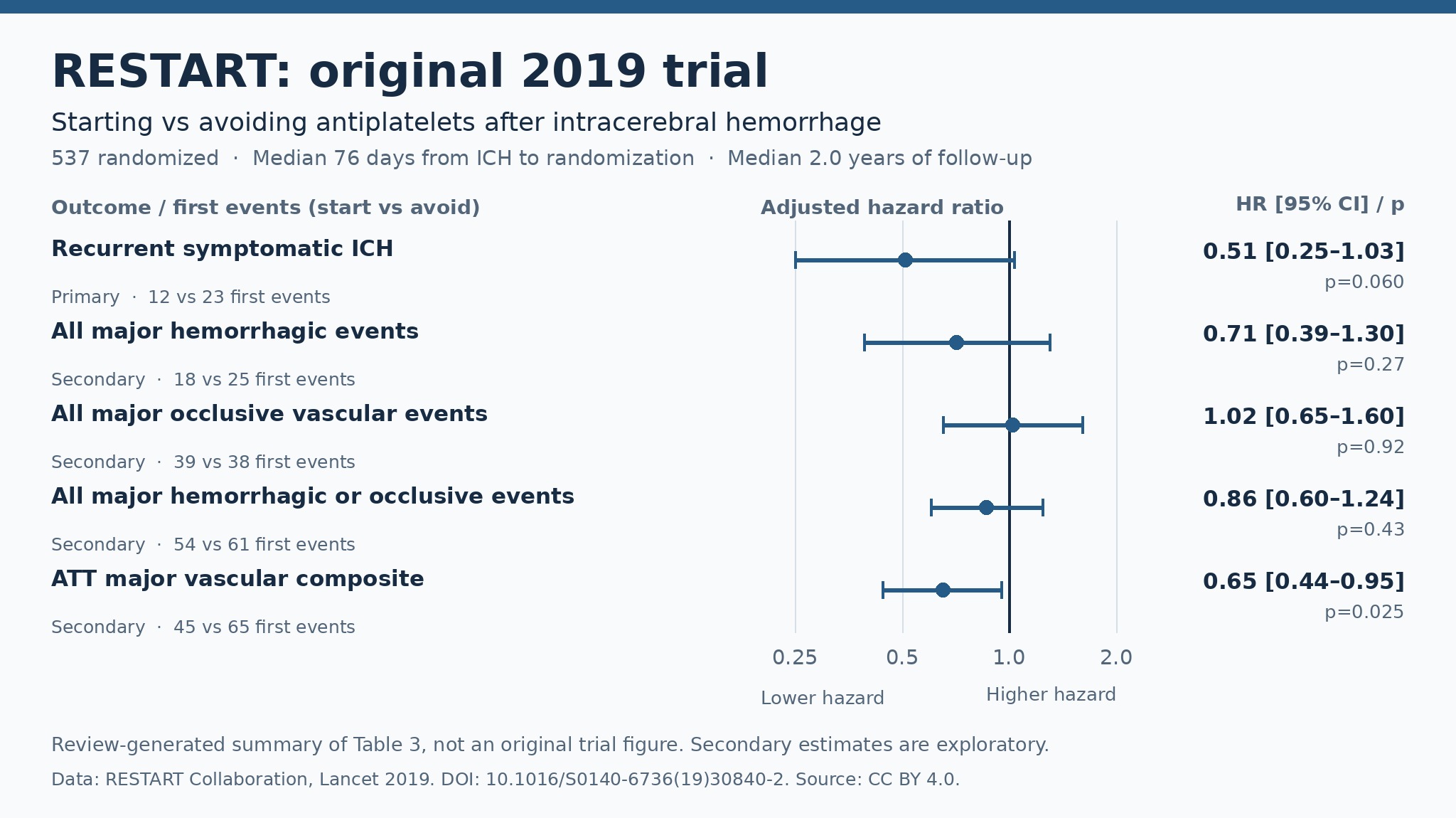
Among 537 randomized participants, recurrent symptomatic ICH occurred in 12 of 268 assigned to start antiplatelet therapy (4%) and 23 of 268 assigned to avoid it (9%): adjusted hazard ratio (HR) 0.51 (95% CI 0.25–1.03; p=0.060). The interval is reassuring against a large increase in recurrent-ICH hazard in this selected, mostly delayed-resumption population; crossing the null means protection was not established, not that the trial learned nothing about harm. This was not a formal noninferiority trial and does not establish net benefit, very-early restart safety, or a universal resumption rule.
Design
- Trial type: Investigator-led, pragmatic, prospective, parallel-group randomized trial; open-label treatment with blinded endpoint assessment; no placebo.
- N: 537 randomized.
- Start antiplatelet therapy: 268.
- Avoid antiplatelet therapy: 269; one participant withdrew before the first follow-up. Outcome analyses included 268 participants per group.
- Randomization: Central computerized 1:1 allocation with minimization on five baseline variables, including ICH location, time since onset, age, physician-preferred antiplatelet agent, and predicted six-month outcome.
- Setting: United Kingdom; 122 hospital sites activated, of which 104 recruited participants.
- Enrollment: 2013–2018; follow-up ended in 2018.
- Median follow-up: 2.0 years (IQR 1.0–3.0); reported follow-up completeness was 99.3%.
- Analysis: Assigned-group analysis of all randomized participants except the one withdrawal; Cox models adjusted for the minimization variables.
- Primary outcome: Fatal or nonfatal, radiographically or pathologically confirmed recurrent symptomatic ICH.
Population
Inclusion criteria
- Adults with spontaneous ICH confirmed by brain imaging who survived at least 24 hours.
- Antiplatelet or anticoagulant therapy had been used to prevent occlusive vascular disease when ICH occurred and was then discontinued.
- The patient or representative and treating physician were uncertain whether antiplatelet therapy should be started or avoided.
Exclusion criteria
- ICH due to preceding head injury, hemorrhagic transformation of ischemic stroke, or intracranial bleeding without parenchymal ICH.
- Antithrombotic therapy still being taken at consent after the ICH.
- Other protocol exclusions included pregnancy, breastfeeding, childbearing potential without contraception, and inability of the patient or carer to understand spoken or written English.
Baseline profile
- Median age (IQR), start versus avoid: 77 (69–82) versus 76 (69–82) years.
- Male: 65% versus 70%; White: 94% versus 90%.
- Lobar ICH: 62% in both groups; 88% of the overall cohort had prior occlusive vascular disease.
- ICH-to-randomization interval: Median 76 days (IQR 29–146) overall; 74% of each arm was randomized after day 30.
- Treatment context: Median systolic blood pressure during follow-up was 130 mm Hg in a cohort where most received blood-pressure-lowering medication. This was a survivor and clinical-equipoise population, not an unselected acute-ICH cohort.
Interventions
- Start antiplatelet therapy: One or more oral agents—aspirin, dipyridamole, or clopidogrel—started within 24 hours of randomization. The responsible consultant chose the agent and dose; regimens were predominantly monotherapy.
- Avoid antiplatelet therapy: A policy of avoiding antiplatelet therapy; there was no placebo. During follow-up, clinicians could start or stop antiplatelet or anticoagulant therapy when clinically indicated, regardless of assignment.
- Scope: The randomized intervention was antiplatelet therapy. The fact that some participants had been taking an anticoagulant when ICH occurred does not make RESTART an anticoagulation-resumption trial.
Outcomes
Primary outcome — recurrent symptomatic ICH
- 12/268 (4%) with assignment to start antiplatelet therapy versus 23/268 (9%) with assignment to avoid it.
- Adjusted HR 0.51 (95% CI 0.25–1.03; p=0.060). The confidence interval includes no difference; the point estimate alone is not proof of a protective effect.
Secondary outcomes
- Major hemorrhagic events: 18/268 (7%) versus 25/268 (9%); adjusted HR 0.71 (95% CI 0.39–1.30; p=0.27).
- Major occlusive vascular events: 39/268 (15%) versus 38/268 (14%); adjusted HR 1.02 (95% CI 0.65–1.60; p=0.92). This composite included venous events and revascularization procedures as well as arterial ischemic events.
- Combined major hemorrhagic or occlusive events: 54/268 (20%) versus 61/268 (23%); adjusted HR 0.86 (95% CI 0.60–1.24; p=0.43).
- Protocol-specified Antithrombotic Trialists' major-vascular composite: 45 versus 65 first events; adjusted HR 0.65 (95% CI 0.44–0.95; nominal p=0.025). Its components were nonfatal myocardial infarction, nonfatal stroke—including hemorrhagic or uncertain-type stroke—or vascular death. It is a different endpoint from the broader occlusive-event composite, and its favorable exploratory result is not proof of a purely ischemic or overall net benefit.
- The distribution of modified Rankin Scale scores during follow-up did not differ between groups.
Prespecified exploratory subgroups
The authors reported no evidence of treatment-effect heterogeneity by the minimization variables, prior antithrombotic therapy, or atrial-fibrillation history. These were exploratory interaction analyses with few recurrent events; a nonsignificant interaction does not establish identical safety across ICH locations, imaging phenotypes, or restart intervals.
Adverse events / safety
The primary endpoint itself was recurrent ICH. The trial did not detect a significant increase in the broader major-hemorrhage composite, but the event count and confidence interval leave uncertainty. Serious adverse events that were neither outcome events nor expected stroke complications were uncommon. These findings concern the selected, randomized population and should not be generalized to dual antiplatelet therapy or anticoagulation.
Figures
Data: RESTART Collaboration, Lancet 2019, Table 3, PMC6617509, published under CC BY 4.0. Click the chart to expand.
The source also identifies three original figures, but its JATS export supplied no verifiable CDN paths. They are not embedded, and no legacy image URLs were reconstructed.
Criticisms
- The trial randomized 537 participants against a planned target of 720. Investigators recruited only about one in twelve eligible patients; many were too unwell or their physicians were already certain about treatment. The clinical-equipoise selection improves relevance to uncertainty but narrows generalizability.
- The primary estimate is imprecise and did not cross the conventional significance threshold (p=0.060). The observed 12-versus-23 event count should not be retold as a proven 49% reduction in ICH.
- Randomization occurred a median of 76 days after ICH; most participants entered more than 30 days after onset. The trial therefore does not establish the safety of very early resumption.
- The cohort was older, predominantly male and White, and recruited in the UK. Subgroup analyses were exploratory and were not a reliable basis for declaring benefit or safety in a particular imaging phenotype.
- Treatment was open-label, although endpoint adjudicators were masked. Agent and dose were chosen by clinicians; the trial does not establish the effect of dual therapy, a specific dose, or restarting oral anticoagulation.
- A secondary major-vascular composite favored antiplatelet assignment, but secondary outcomes were interpreted under the trial's prespecified hierarchy without a general multiplicity adjustment. It is supportive context, not a replacement for the inconclusive primary result.
Funding
The British Heart Foundation funded the trial through a Special Project grant (SP/12/2/20422). The University of Edinburgh and NHS Lothian were co-sponsors. The article states that the funder had no role in study design, data collection, analysis, interpretation, manuscript preparation, or the decision to submit. The paper reports investigator disclosures, including grants and fees; see the original article for the itemized declarations.
The paper
- Authors: RESTART Collaboration.
- Title: Effects of antiplatelet therapy after stroke due to intracerebral haemorrhage (RESTART): a randomised, open-label trial.
- Journal: The Lancet. 2019;393(10191):2613–2623. Published online May 22, 2019; issue date June 29, 2019.
- DOI: 10.1016/S0140-6736(19)30840-2
- PMID: 31128924
- PMCID: PMC6617509
- Trial registration: ISRCTN71907627.
Deep Dive — click to expand
The tags below distinguish facts from the article [F], inferences [I], hypotheses requiring testing [H], and missing variables [M].
What this is
RESTART tested a delayed antiplatelet-resumption policy against avoidance in selected survivors of spontaneous ICH that had occurred during prior antithrombotic use. The central result is a numerically lower recurrence estimate with a confidence interval that crosses the null; the paper offers qualified reassurance, not a definitive efficacy result or a universal treatment rule.
1. Shadow Audit
- [F] The primary endpoint was recurrent symptomatic ICH: 12/268 versus 23/268, adjusted HR 0.51 (95% CI 0.25–1.03; p=0.060). The study did not establish a statistically significant reduction.
- [F] Enrollment required uncertainty about whether to start or avoid antiplatelets. The investigators recruited only about one in twelve eligible people; many eligible patients were too unwell or their physicians were already certain.
- [I] The headline point estimate draws attention toward possible benefit, while the more durable interpretation is narrower: this trial did not detect an excess in its selected population, but it cannot certify safety for patients who were excluded or never randomized.
- [H] If excluded patients differ in baseline bleeding risk or care trajectories, the trial estimate may not transport to them; the direction and size of that difference remain unknown.
- [M] Event counts were too sparse to provide dependable assurance for every ICH location, imaging phenotype, or very-early restart interval.
2. Inversion Engine
- [F] The primary 95% CI crosses HR 1.0, and the p value was 0.060; the intended sample size was not reached.
- [I] A null effect remains compatible with the result, so the observed reduction is not established protection. But the primary model's upper confidence limit is 1.03, not a large harmful HR: uncertainty about benefit must not be mistaken for an absence of reassurance against large recurrent-ICH harm in the trial population.
- [I] To overturn that reassurance within the same population, a materially harmful overall HR would have to lie beyond the reported upper bound, or the model, ascertainment, or transport assumptions would have to fail. This interval is not a formal noninferiority margin and does not constrain an inadequately studied high-risk subgroup in the same way.
- [H] A clinically important effect in a narrowly defined high-risk subgroup could be obscured by an overall average, but RESTART does not establish such a subgroup effect.
- [M] More precise estimates by timing and imaging phenotype, with enough recurrent events, are needed to test that possibility.
3. Second-Order Catalyst
- [F] Participants were randomized a median of 76 days after ICH. The assigned treatment was antiplatelet therapy, even though some participants had been taking anticoagulants when their ICH occurred.
- [I] The result is most useful for separating two questions that are often collapsed: whether to resume an antiplatelet agent after a delay, and whether or when to resume anticoagulation. RESTART only randomized the first.
- [H] A shared decision pathway that records the antithrombotic indication, treatment class, and timing might reduce blanket decisions, but the trial did not test that implementation strategy.
- [M] Patient preference, local practice effects, and outcomes under a formal risk-stratified implementation pathway were not tested.
4. Asymmetric Leverage
- [F] Most participants used blood-pressure-lowering medication and achieved a median systolic pressure of 130 mm Hg; 74% of each arm was randomized after day 30, and the antiplatelet regimens were mainly monotherapy.
- [I] The inexpensive leverage point is an applicability check, not a stronger slogan about p=0.060: make the antithrombotic indication and class, ICH-to-treatment interval, and blood-pressure context explicit before invoking RESTART. Those trial conditions are not interchangeable with immediate resumption, dual therapy, anticoagulation, or uncontrolled blood pressure.
- [H] A brief structured follow-up record could reduce inappropriate extrapolation without requiring a new risk model. RESTART did not test such an implementation intervention.
- [M] The paper does not establish the effect of that workflow, an optimal blood-pressure target, the best antiplatelet agent or dose, or the earliest safe restart day.
5. Paradigm Destroyer
- [F] The trial was open-label, endpoint assessment was masked, and the primary outcome result was not statistically significant. Most eligible patients were not randomized because they were too unwell, their clinicians were certain, or for other reasons.
- [I] RESTART weakens the automatic assumption that antiplatelet therapy must always be withheld indefinitely after ICH in every selected survivor; it does not justify routine restarting.
- [H] The strongest skeptical account is that chance and selection explain the lower recurrence point estimate, while the secondary vascular signal is vulnerable to the number of outcomes examined.
- [M] A larger randomized evidence base with adequate event counts and prespecified timing and imaging strata would most change confidence.
MVP — Minimum Viable Proof
- [F] In the population actually randomized, recurrent ICH was 12/268 versus 23/268; adjusted HR 0.51 (95% CI 0.25–1.03; p=0.060).
- [I] The defensible takeaway is qualified reassurance against a large recurrent-ICH hazard in similar selected survivors, with no established protective effect. Neither “p>0.05 means nothing was learned” nor “resumption is safe for everyone” is an accurate reading.
Best Combination
- [F] The article situates its randomization against prior observational evidence about restarting antiplatelets after intracranial bleeding.
- [I] Use the randomized estimate as the causal anchor for its eligible population, then compare other evidence only after matching treatment class, time since ICH, and phenotype. Do not blend antiplatelet and anticoagulant resumption as though they were the same intervention.
- [M] This draft reviews the original 2019 report; it does not perform a current systematic review of later evidence or guidelines.
Overvalue Warning
- [F] The primary p value was 0.060, the confidence interval crossed HR 1.0, and enrollment fell short of target.
- [I] Readers may overvalue the 0.51 point estimate or a favorable secondary composite and undervalue selection, sparse recurrent events, and uncertainty about treatment timing.
- [H] Later pooled data could narrow uncertainty, but only if the included trials are sufficiently comparable.
- [M] The result does not resolve early restart, anticoagulants, dual therapy, or treatment effects in high-risk imaging subgroups.
Educational use notice. The Time Is Brain Review is dedicated to medical education. This evidence summary is not patient-specific medical advice. See our editorial notice for the full policy.