Robot-assisted integrated cognitive-motor rehabilitation in chronic stroke — a motor signal, not a cognitive win
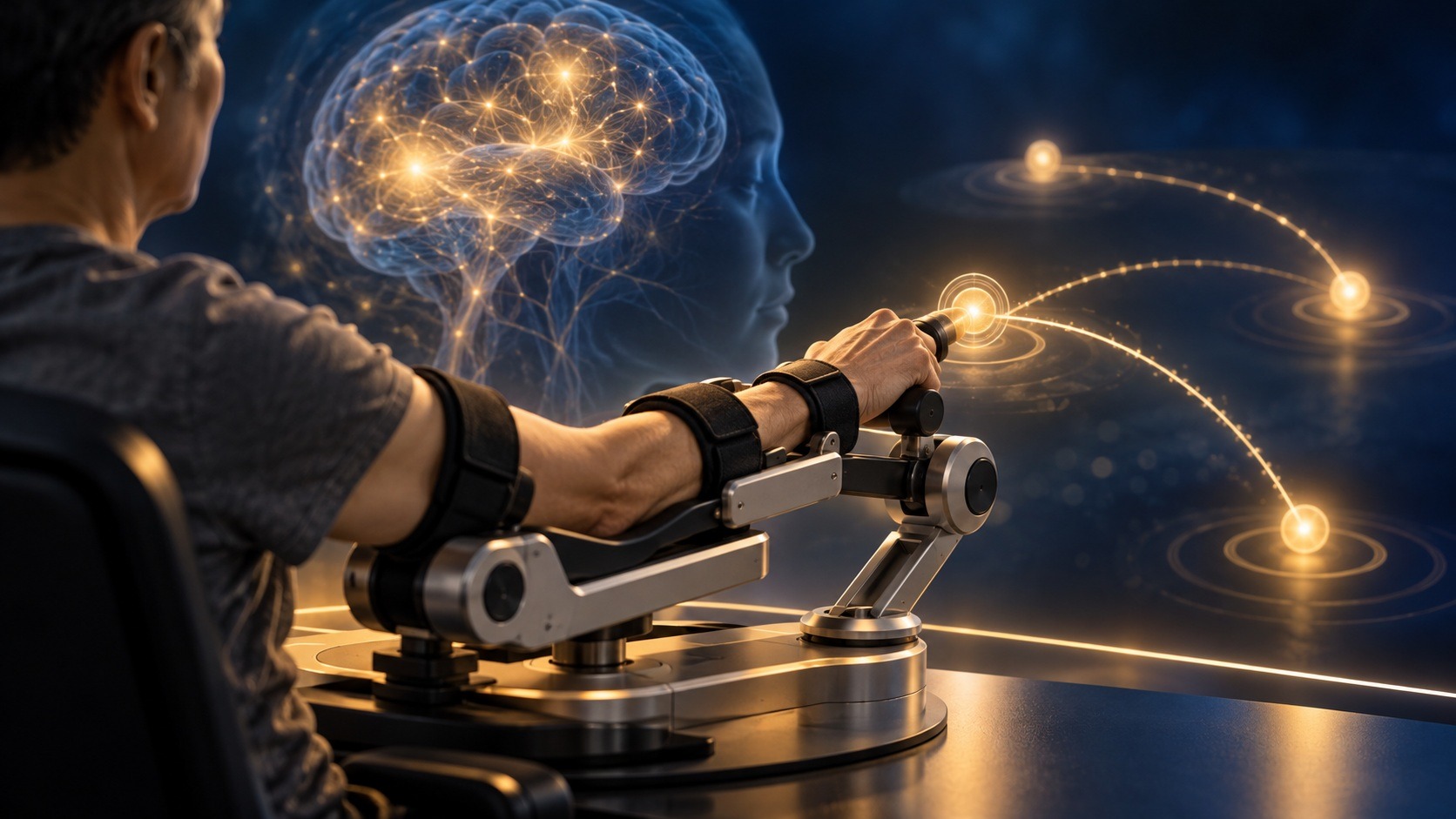
Clinical Question (PICO)
In adults with chronic stroke, unilateral hemiparesis and cognitive impairment, does three weeks of integrated cognitive–motor training using an end-effector arm robot improve global cognition more than time-matched conventional paper-based cognitive rehabilitation? Secondary questions concern upper-limb impairment and daily functioning. The report presents no prespecified subgroup treatment-effect analyses. This is a look-back review of a trial published on August 13, 2026, not a new October trial report. Methods.
Bottom Line
The primary cognitive hypothesis was not confirmed: between-group comparisons were nonsignificant for MMSE (P=0.403) and MoCA (P=0.512). An exploratory motor outcome favored robotic training: FMA-UE rose from 33.6 to 37.5 versus 25.7 to 25.9 in controls (between-group P=0.012; Cohen’s d=0.98), without a demonstrated advantage in activities of daily living. Results and Table 2.
Design
- Trial type: Single-center, randomized, assessor-blinded exploratory superiority trial; the visibly different treatments did not permit participant or treating-therapist blinding.
- N: 30 randomized and analyzed, 15 per group; 33 screened and 3 excluded. Everyone randomized completed the intervention and post-treatment evaluation.
- Randomization: 1:1, computer-generated fixed blocks of 2 by an independent researcher. Allocation used sequentially numbered opaque sealed envelopes opened after baseline assessment. No stratification is described.
- Setting: Asan Medical Center, Seoul, Republic of Korea.
- Enrollment / trial period: First enrollment August 12, 2025; final participant’s post-intervention evaluation February 23, 2026. The latter is not separately identified as the enrollment end date.
- Follow-up: Immediate post-intervention assessment after the three-week treatment course; no longer-term follow-up and no separate mean follow-up reported.
- Analysis: All randomized participants were included, with no missing observations or imputation. Paired t-tests assessed within-group changes; ANCOVA adjusted between-group comparisons for baseline scores. Benjamini–Hochberg false-discovery-rate correction applied to secondary CERAD cognitive subdomains, not a stated global correction across all outcomes.
- Primary outcomes: Global cognition measured with Korean MMSE and Korean MoCA, assessed before and after training. These are continuous scores, not event outcomes.
- Power assumption: The authors based 15 participants per arm on an anticipated 2.5-point MoCA difference, SD 2.3, 80% power and two-sided alpha 0.05, using prior mild-cognitive-impairment literature rather than this exact stroke population.
Design details: Methods.
Population
Inclusion Criteria
- Age at least 19 years; stroke with unilateral hemiparesis.
- Affected upper-limb Modified Ashworth Scale ≤3 and elbow manual muscle testing ≥2.
- Korean MMSE ≤26.
Exclusion Criteria
- Severe communication disorders or severe cognitive impairment.
- Significant medical or neurological comorbidity affecting participation.
- Recent participation in another stroke-related device trial.
- The main report does not supply a separate numeric threshold defining “severe” cognitive impairment; do not infer one.
Baseline Characteristics (robotic group / control)
- Age: 68.2±7.8 / 67.6±9.9 years; women: 9/15 in each group.
- Time since stroke: 167.3±60.6 / 163.3±61.6 months, as reported in Table 1. This is a very longstanding-stroke cohort, not an early recovery cohort; the unusual duration merits confirmation before extrapolation.
- Ischemic stroke: 11/15 / 8/15; hemorrhagic stroke: 4/15 / 7/15.
- Baseline MMSE: 24.7 / 23.8; MoCA: 21.7 / 20.4.
- Baseline FMA-UE: 33.6 / 25.7; MBI: 89.3 / 84.6. The motor-score imbalance matters despite random allocation.
Eligibility and baseline values: Methods, Table 1, Table 2.
Interventions
- Robot-assisted cognitive–motor rehabilitation: Rebless Planar end-effector system (H. Robotics), supervised by trained rehabilitation therapists. Ten 30-minute sessions over three weeks, at least twice weekly: 5 minutes of preparation and 25 minutes of goal-directed dual-task training. Reaching movements selected answers or targets during maze navigation, calculation, sentence completion, orientation, pattern matching and tracing. Cognitive difficulty, selection dwell time and robotic assistance were individually adjusted. The device logged an average of 525.8±63.9 trials across the treatment course and 82.9% task success.
- Conventional cognitive rehabilitation: Individually tailored paper-based exercises covering orientation, memory, attention and executive tasks, using an errorless-learning approach. The same ten 30-minute sessions over three weeks, but without a matched active upper-limb motor-training component.
The scheduled duration was matched; the motor workload was not. This compares two therapy packages, not a robot against an equal dose of nonrobotic reaching practice. Intervention methods.
Outcomes
Primary Outcomes — global cognition
| Measure | Robot, baseline → post-treatment | Control, baseline → post-treatment | Unadjusted difference in mean change* | Reported Cohen’s d | Between-group P |
|---|---|---|---|---|---|
| MMSE | 24.7±2.6 → 26.9±2.2 | 23.8±3.4 → 25.2±3.0 | +0.8 points | 0.31 | 0.403 |
| MoCA | 21.7±4.5 → 24.5±1.7 | 20.4±5.3 → 22.4±4.3 | +0.8 points | 0.24 | 0.512 |
Both groups improved within group, but that is not evidence of superiority. The robotic-group within-group P values were 0.008 for MMSE and 0.013 for MoCA; corresponding control values were 0.039 and 0.012. Neither superiority nor equivalence/noninferiority was established.
Secondary Outcomes
| Measure | Robot, baseline → post-treatment | Control, baseline → post-treatment | Unadjusted difference in mean change* | Reported Cohen’s d | Between-group P |
|---|---|---|---|---|---|
| FMA-UE, upper-limb motor impairment | 33.6±16.5 → 37.5±17.1 | 25.7±14.8 → 25.9±15.8 | +3.7 points | 0.98 | 0.012 |
| MBI, activities of daily living | 89.3±6.8 → 90.8±6.7 | 84.6±10.1 → 86.2±9.5 | −0.1 points | −0.02 | 0.959 |
Differences in mean change are this review’s arithmetic from rounded published means, not adjusted ANCOVA coefficients. The paper reports between-group P values and standardized effect sizes, but does not report 95% confidence intervals or adjusted mean-difference estimates for these comparisons. HR/OR/RR are not applicable to these continuous-score outcomes; no confidence interval has been reconstructed from insufficient information.
All 12 CERAD secondary cognitive subdomain comparisons were nonsignificant after false-discovery-rate adjustment. Examples include word-list memory (d=0.74; adjusted P=0.413), word-list recall (d=0.05; P=1.000) and Trail Making Test A (d=−0.31; P=0.852). Within-group improvements in selected tests do not rescue the between-group cognitive claim. No subgroup estimates or interaction tests were reported. All outcome values: Table 2.
Adverse Events / Safety
No adverse events were reported during the study; all 30 participants completed treatment and evaluation. No technical malfunction or system error was reported. This establishes short-course feasibility in a small selected sample, not a precise estimate of rare harms or long-term safety. Intervention-group satisfaction ranged from 3.20 to 3.73 on a four-point scale; controls did not supply a corresponding device-satisfaction comparison. Results.
Figures

Source: Cha et al., Frontiers in Neurology (2026), PMC13518322, CC BY 4.0 — fneur-17-1866135-g001.webp. Image unmodified; caption paraphrased. Click image to expand.

Source: Cha et al., Frontiers in Neurology (2026), PMC13518322, CC BY 4.0 — fneur-17-1866135-g002.webp. Image unmodified; caption paraphrased. Click image to expand.

Source: Cha et al., Frontiers in Neurology (2026), PMC13518322, CC BY 4.0 — fneur-17-1866135-g003.webp. Image unmodified; caption paraphrased. Click image to expand.

Source: Cha et al., Frontiers in Neurology (2026), PMC13518322, CC BY 4.0 — fneur-17-1866135-g004.webp. Image unmodified; caption paraphrased. Click image to expand.
Criticisms
- The primary endpoint was negative. Calling the intervention broadly effective would substitute an exploratory secondary motor result for an unconfirmed cognitive hypothesis. This limitation is explicitly acknowledged by the authors. Discussion.
- Comparator limits attribution. The control group did not perform matched motor training. The study cannot isolate the robot, gamification or dual-task integration from simply adding reaching practice. A dose-matched active motor comparator is the decisive missing experiment. Methods and discussion.
- Statistical significance is not clinical importance. The robot group’s 3.9-point mean FMA-UE gain is below the 4.25–7.25-point chronic-stroke importance range cited by the authors. That published range is context-dependent and an individual-change benchmark, not a universal threshold for between-group efficacy. MBI showed no treatment advantage. Discussion.
- Imprecision and multiplicity remain. Only 15 participants per arm, absent treatment-effect confidence intervals, two primary cognitive scores and multiple secondary outcomes limit certainty. The stated multiplicity correction covered CERAD subdomains; the motor P=0.012 should remain exploratory. Statistical methods and Table 2.
- Baseline motor imbalance and allocation predictability. FMA-UE differed by 7.9 points at baseline. ANCOVA addresses observed baseline scores but does not eliminate small-sample instability. Fixed blocks of two could permit prediction if previous assignments became known, although the report describes allocation concealment and does not document a breach. The predictability concern is this review’s methodological inference. Methods.
- Durability and transfer are unproven. No later follow-up, activity-level arm-performance endpoint, cost-effectiveness analysis or mechanistic imaging was supplied. High baseline MBI may limit room for improvement; this ceiling concern is an inference, not a demonstrated explanation for the null result. Table 2 and limitations.
- External validity is narrow. A single Korean center and selected participants with very longstanding stroke, residual arm movement and ability to engage with the tasks do not establish benefit in acute stroke, severe aphasia or profound cognitive impairment. These criticisms reflect the full report and this review’s appraisal, not an independently retrieved editorial.
Funding
Supported by the Korea Health Technology R&D Project through the Korea Health Industry Development Institute, funded by the Ministry of Health & Welfare, Republic of Korea (RS-2024-00335457). The article does not explicitly describe the funder’s operational role. The authors declared no commercial or financial relationships constituting a potential conflict. Registration: Korean Clinical Research Information Service KCT0010564, as reported in the article; registry timing and concordance were not independently established here. Funding statement.
The paper
- Authors. Seungwoo Cha, Jiyeon Lee, Hyojin Jeon and Min Ho Chun.
- Title. Robot-assisted integrated cognitive-motor rehabilitation in patients with chronic stroke: a randomized controlled trial.
- Journal. Frontiers in Neurology, volume 17, article 1866135.
- Year. 2026; published August 13.
- DOI. 10.3389/fneur.2026.1866135
- PMCID. PMC13518322
- PMID. 42661753
- Source and figure license. Open access, Creative Commons Attribution 4.0. Figures above are reproduced unmodified from Cha and colleagues; captions are paraphrased for this review with attribution. The full PMC JATS source and extracted text were archived and reviewed.
Deep Dive — click to expand
What this is
[F] This August 2026 exploratory trial asked whether moving the affected arm through cognitively demanding robotic tasks would outperform conventional cognitive therapy on cognition. It did not: the reported MMSE and MoCA comparisons were P=0.403 and P=0.512. [I] Its useful contribution is a hypothesis about fitting motor practice into cognitive-therapy time, not proof that a robot improves cognition or daily independence. The distinction rests on the null cognitive endpoints, the positive secondary FMA-UE result and the null MBI comparison. Trial facts in this commentary refer to the full report and Table 2. Tags distinguish [F] reported facts, [I] interpretation or derived arithmetic, [H] hypotheses, and [M] missing evidence.
1. Shadow Audit
[F] The motor contrast was +3.9 versus +0.2 FMA-UE points, but only one arm received structured reaching practice; activities of daily living did not differ (P=0.959). [I] The hidden denominator is therefore motor-practice exposure, not simply therapy minutes: an apparently technology-specific benefit can emerge from a package that contains extra movement. [M] There is no nonrobotic reaching arm matched for repetitions, cognitive difficulty and therapist contact, and no demonstration that better impairment scores translated into more useful arm activity. [H] A short, assessor-blinded comparison against matched tabletop reaching tasks would distinguish a device-specific effect from a practice-content effect more efficiently than another comparison against worksheets. Intervention design and limitations.
2. Inversion Engine
[I] From the rounded means, the raw motor change contrast is +3.7 points; a motor-matched comparator producing an additional 3.7 points over this paper’s worksheet control would erase that contrast. This is a counterfactual arithmetic threshold, not an estimated response to such a comparator. [F] The robot group’s average 3.9-point gain also falls 0.35 points below the lower end of the 4.25–7.25 range cited by the authors, while primary cognition did not show superiority. [I] To invert the cautious conclusion into a clinical adoption case requires more than another small P value: a replicated, precise treatment contrast, evidence of worthwhile activity-level benefit and persistence after treatment ends. [M] Without confidence intervals and later follow-up, this report cannot tell us how much benefit remains plausible or how long it lasts. Table 2 and discussion.
3. Second-Order Catalyst
[H] The first plausible adopter is an outpatient neurorehabilitation team that already owns the device and treats patients resembling this selected longstanding-stroke cohort—not an acute stroke unit or a hospital purchasing a system on this trial alone. [I] A reversible service pilot could test whether integrated sessions add useful reaching practice while preserving cognitive engagement; the study’s complete attendance and absence of reported adverse events support feasibility, not therapeutic equivalence. [M] Therapist workload, setup time in this trial, costs and displacement of other effective therapy were not quantified. [H] The downstream risk is counting dual-purpose sessions as delivery of two proven treatments when neither durable motor transfer nor cognitive noninferiority has been established. Measure blinded arm activity and retained cognition before scaling the pathway. Feasibility results and limitations.
4. Asymmetric Leverage
[I] The small leverage point is the content of an existing 300-minute scheduled treatment course, not necessarily new hardware. [F] The trial delivered ten 30-minute sessions and logged 525.8 average robotic task attempts, yet found no cognitive superiority and no MBI advantage. [H] A service with existing equipment could first audit achieved repetitions, therapist minutes and a patient-selected arm task; a service without equipment could test a lower-cost nonrobotic cognitive–reaching format as an unproven alternative. [I] Either approach makes procurement conditional on an observable functional payoff rather than on a large standardized effect (d=0.98) in a small secondary analysis. [M] No cost or throughput advantage can be calculated from the paper. Methods and results.
5. Paradigm Destroyer
[I] The reflex to discard is “significant improvement inside the robotic arm means the robot worked better.” [F] Both groups improved on cognitive screening, neither primary between-group comparison was significant, and the motor comparator lacked motor training. [I] A two-sentence protocol update would be: “Do not substitute robotic cognitive–motor training for established cognitive or motor therapy on the assumption of cognitive superiority. If trialed in selected chronic-stroke patients, record the active motor dose and assess blinded functional transfer; do not label the secondary motor signal a confirmed clinical benefit.” [H] The strongest test of that conservative position is a prespecified primary motor/activity endpoint against equal motor and cognitive exposure, with follow-up beyond treatment. Discussion.
MVP — Minimum Viable Proof
[F] This paper supplies a +3.9 versus +0.2 FMA-UE change, P=0.012, alongside null primary cognitive comparisons. [I] That is enough to justify a better-controlled trial, not routine device adoption. [H] The minimum practice-changing proof would be a prespecified, clinically worthwhile between-group motor or arm-activity benefit with a confidence interval excluding trivial benefit, sustained after therapy and not purchased at the cost of poorer cognition or displaced care. [M] This study provides none of those confirmatory precision or durability tests. Table 2.
Best Combination
[F] In the larger 2019 RATULS trial, 770 participants were randomized to MIT-Manus robot training, enhanced upper-limb therapy or usual care. At three months, Action Research Arm Test success occurred in 44%, 50% and 42% of assessed participants, respectively; robot versus usual care had adjusted OR 1.17 (98.3% CI 0.70–1.96), and robot versus enhanced therapy had adjusted OR 0.78 (0.48–1.27). These values come from the retrieved primary trial abstract, not a fresh full-text appraisal. RATULS primary report.
[I] Stack Shadow Audit → Asymmetric Leverage: first identify the unmatched motor content, then ask whether useful practice can be delivered efficiently without assuming that hardware creates the benefit. [I] RATULS does not directly refute this different device, population or dual-task program, but it makes the leap from an impairment-score signal to routine functional benefit especially unsafe. The combined lesson is to compare against an active motor alternative and prioritize activity-level outcomes, not to claim that all rehabilitation robots work or that none can work.
Overvalue Warning
- [I] Do not convert null superiority into equivalence. MMSE P=0.403 and MoCA P=0.512 do not establish preservation of cognitive benefit in a noninferiority sense; within-group gains cannot identify treatment efficacy without the relevant contrast. Table 2.
- [I] Do not turn an exploratory impairment effect into durable independence or proven neuroplasticity. The motor effect lacks a matched motor comparator and reported confidence interval, MBI did not favor treatment, and the trial included neither long-term follow-up nor mechanistic imaging. [M] Rare harms, long-term costs and which patients benefit remain unresolved. Limitations.
Educational use notice. The Time Is Brain Review is dedicated to medical education. Figures from published articles are embedded for teaching purposes, with attribution to the original publication. We do not claim copyright over any embedded figure; all rights remain with the original publisher and authors under the article's published license. If you are a rights holder and would like a figure removed, please contact the editorial team. See our editorial notice for the full policy.