Clinical study of isokinetic training with joint control tasks on lower limb function in stroke patients with proprioceptive impairment: a preliminary randomized controlled trial — a sensory signal, not a device mandate
Clinical Question (PICO)
In adults with a first ischemic or hemorrhagic stroke, unilateral weakness and documented proprioceptive impairment 2 weeks to 6 months after onset, does adding isokinetic knee flexion–extension training with real-time visual feedback to conventional rehabilitation improve knee position sense, lower-limb motor function, balance and daily activities after 4 weeks, compared with conventional rehabilitation alone? No treatment-effect subgroup analyses were reported; the three knee test angles are repeated outcome measurements, not patient subgroups. This review examines a paper published in October 2026, not a long-term outcomes study.
Bottom Line
Zhang and colleagues conclude that isokinetic joint-control training may be a useful adjunct, while explicitly calling for more rigorous confirmation. Among 58 participants, knee position-reproduction error at 30° fell by 0.81° with the add-on versus 0.25° with conventional rehabilitation alone: a calculated additional reduction of 0.56° (reported between-group P = 0.004). Functional scores also favored the add-on, but this preliminary, unblinded, unequal-dose comparison does not establish durable independence, fall prevention or a device-specific mechanism.
Design
- Trial type: Prospective, single-center randomized controlled trial; allocation was not concealed and outcome assessors knew treatment assignment. No participant or therapist blinding procedure was described.
- N: 58 randomized and analyzed.
- Conventional rehabilitation: 29.
- Conventional rehabilitation plus isokinetic joint-control training: 29.
- Randomization: Equal-sized groups assigned using a random-number table; the researcher generating the sequence also assigned participants. No stratification was described.
- Setting: Department of Rehabilitation Medicine, Beijing Tiantan Hospital, Capital Medical University, China.
- Enrollment: April–November 2025.
- Follow-up: Assessment before treatment and immediately after the 4-week program; no later follow-up or mean follow-up estimate was reported.
- Analysis: Between-group comparisons of post-minus-baseline change scores, using independent-samples t tests or Mann–Whitney U tests as appropriate. Within-group paired tests were also reported. No baseline-adjusted ANCOVA, global multiplicity correction or explicit intention-to-treat/missing-data strategy was described.
- Primary outcome: Knee joint position-reproduction error (JPR), measured as mean absolute angular error at 30°, 45° and 60°. The paper labels JPR error primary but does not clearly identify a single confirmatory test angle; Nottingham sensory scores and passive-motion detection support the sensory assessment.
Population
Inclusion Criteria
- CT- or MRI-confirmed first stroke, ischemic or hemorrhagic; age 18–80 years; unilateral limb dysfunction.
- Stroke onset 2 weeks to 6 months earlier.
- Affected lower-limb Brunnstrom stage III or above and knee flexor/extensor strength at least grade 3.
- Clinically diminished or absent proprioception and written informed consent.
Exclusion Criteria
- Knee flexor/extensor Modified Ashworth Scale score ≥3.
- Other causes of deep sensory loss or lower-limb joint pain.
- Montreal Cognitive Assessment score <20, neglect or apraxia.
- Severe cardiac, hepatic or renal dysfunction, or malignant hypertension.
Baseline Characteristics
- Mean age: 59.76 years in controls and 56.93 years in the experimental group.
- Men/women: 20/9 and 21/8, respectively.
- Ischemic/hemorrhagic strokes: 22/7 and 21/8.
- Median time since stroke: 16 days (IQR 14–25) and 17 days (14–25), respectively. Thus, the actual sample was predominantly very early subacute, despite broader eligibility.
- Mean Berg Balance Scale (BBS): 31.48 and 29.00; mean Fugl–Meyer lower-extremity assessment (FMA-LE): 21.37 and 22.22; mean Modified Barthel Index (MBI): 63.93 and 61.33.
Interventions
- Both groups: Conventional rehabilitation twice daily, 5 days weekly for 4 weeks, including motor practice, balance/gait work, strengthening and proprioceptive interventions. Session duration and total therapist minutes were not specified.
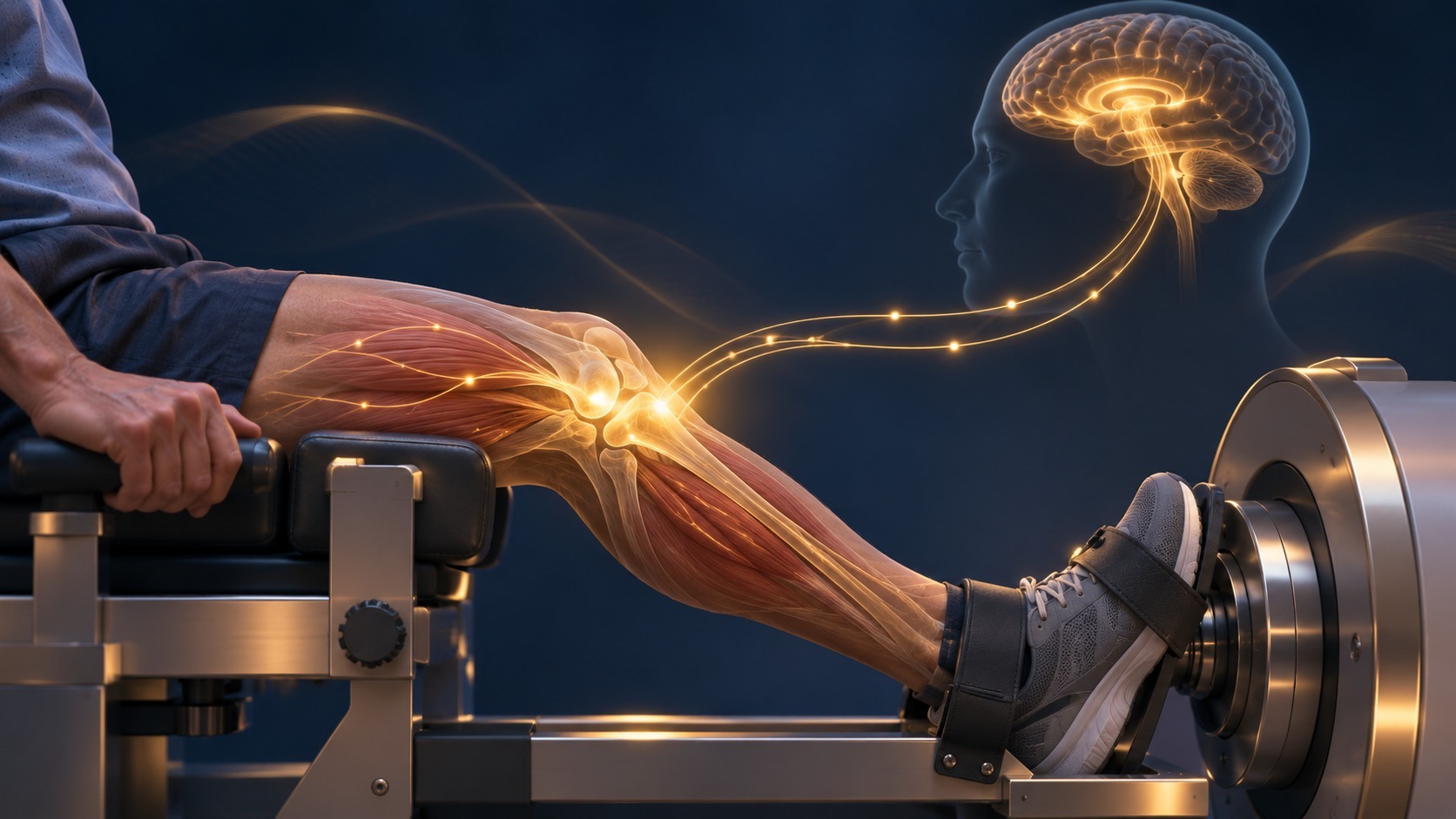
- Experimental add-on: A CON-TREX multi-joint dynamometer, with seated knee flexion–extension over 0°–90°, concentric/concentric mode, gravity compensation and visual torque feedback. Ten sets used velocities of 60, 90, 120, 150, 180, 180, 150, 120, 90 and 60°/second; each set contained 10 repetitions with 60-second rests between sets. Patients were instructed to exert maximal effort, with intensity adjusted to avoid next-day significant fatigue or discomfort.
- Dose: One additional session daily, 5 days weekly for 4 weeks: a calculated 20 extra sessions and 2,000 prescribed contractions. Controls did not receive an equivalent extra session or an active sham intervention.
Outcomes
All values below come from the article's Tables 1–5 unless explicitly labeled calculated. Changes are post-treatment minus baseline. Means are shown with SD; medians with IQR. No HR, OR or RR applies to these continuous outcomes, and no patient-subgroup effects were reported.
Primary Outcome — knee position-reproduction error: Lower error is better.
| Test angle | Control change | Add-on change | Reported between-group P | Reported effect size | Table 5 reported 95% CI |
|---|---|---|---|---|---|
| 30° | −0.25 ± 0.48° | −0.81 ± 0.87° | 0.004 | Cohen's d = 0.643 | 0.19 to 0.93 |
| 45° | −0.36° (−0.97 to −0.07) | −0.94° (−1.70 to −0.37) | 0.033 | r = 0.280 | −0.97 to −0.10 |
| 60° | −0.45 ± 0.40° | −1.07 ± 1.42° | 0.033 | Cohen's d = 0.431 | 0.05 to 1.17 |
CI reporting caution: The source's CI column is reproduced as printed, not relabeled as a CI for Cohen's d or r. Its sign convention is not consistent across rows: the 30° and 60° intervals are positive, whereas the 45° interval is negative. The arm-specific changes consistently favor the add-on, but the publication does not clearly explain a uniform contrast or the interval estimator for rank-based comparisons. The calculated control-minus-add-on mean change at 30° is 0.56°; Table 5 reports an interval of 0.19°–0.93° for that row. We do not manufacture a corrected interval for other rows.
Secondary and supportive outcomes:
| Measure | Control change | Add-on change | Between-group P | Table 5 effect size; reported 95% CI |
|---|---|---|---|---|
| Modified Nottingham sensory assessment | +0.34 ± 0.61 | +0.69 ± 0.60 | 0.035 | d = −0.566; −0.67 to −0.02 |
| Passive-motion detection threshold | −0.50° (−0.67 to −0.20) | −1.20° (−1.60 to −0.67) | <0.001 | r = 0.451; −0.98 to −0.42 |
| BBS | +12.69 ± 8.95 | +18.10 ± 8.95 | 0.025 | d = −0.605; −10.12 to −0.70 |
| FMA-LE | +5.69 ± 3.68 | +7.90 ± 3.44 | 0.022 | d = −0.620; −4.08 to −0.34 |
| MBI | +14 (4–19) | +22 (12–30) | 0.010 | r = 0.338; 4.33 to 13.67 |
The calculated difference in mean gains is 5.41 BBS points and 2.21 FMA-LE points in favor of the add-on. The MBI values are medians; subtracting them is not an individual-level treatment-effect estimate. The CI-definition caution above also applies to this table, particularly rank-based outcomes. No validated clinically important threshold was prespecified for the primary angular-error endpoint, and the trial did not establish fewer falls, improved community walking, reduced mortality or sustained independence.
Adverse Events / Safety: The authors reported no adverse events during the study. With only 58 participants and 4 weeks of observation, this is a reassuring short-term observation, not proof that uncommon harms are absent; a detailed surveillance definition was not provided.
Figures

Source: Zhang et al., Frontiers in Neurology (2026), PMC13696264, CC BY 4.0 — fneur-17-1881854-g0001.webp. Click image to expand.

Source: Zhang et al., Frontiers in Neurology (2026), PMC13696264, CC BY 4.0 — fneur-17-1881854-g0002.webp. Click image to expand.

Source: Zhang et al., Frontiers in Neurology (2026), PMC13696264, CC BY 4.0 — fneur-17-1881854-g0003.webp. Click image to expand.
Criticisms
- Selection and measurement bias: Unconcealed assignment and unblinded assessment weaken the causal interpretation even though the study is described as randomized.
- Treatment-dose confounding: The experimental arm received 20 extra sessions. More practice, attention, strengthening or visual feedback could explain some benefit; the trial does not isolate an isokinetic or proprioception-specific ingredient.
- Multiplicity and endpoint ambiguity: Three primary test angles plus supportive outcomes were evaluated without a global adjustment. No single confirmatory JPR angle is clearly designated in the report.
- Reporting precision: Table 5 mixes contrast signs and leaves some interval estimators unclear. Baseline nonsignificance is not proof of equivalence; change-score comparisons do not fully adjust baseline differences.
- Applicability: One Chinese rehabilitation center, predominantly men, median onset approximately 2 weeks, and exclusions for cognitive impairment, neglect and severe spasticity limit generalization.
- Missing durability and mechanism: No later outcomes, falls endpoint, imaging or neurophysiology. Better task performance does not demonstrate cortical reorganization. All 58 patients appear in the analysis, but an explicit intention-to-treat and missing-data procedure is not described.
Funding
Supported by Beijing Natural Science Foundation (L252084) and Horizontal Research Project (HX-A-2025007). The funding statement does not specify the funders' role in design, analysis or reporting. The authors declared no commercial or financial conflicts. Registration: Chinese Clinical Trial Registry ChiCTR2500111205; the article does not provide an NCT identifier. Registration timing and registry-to-publication outcome concordance were not independently established in this review.
The paper
- Authors. Zhendong Zhang, Huixian Yu, Ping Li, Na Li and Yumei Zhang.
- Title. Clinical study of isokinetic training with joint control tasks on lower limb function in stroke patients with proprioceptive impairment: a preliminary randomized controlled trial.
- Journal. Frontiers in Neurology.
- Year. 2026; published October 12.
- DOI. 10.3389/fneur.2026.1881854
- PMCID. PMC13696264
Deep Dive — click to expand
What this is
This small rehabilitation trial asks whether a knee-focused, feedback-rich add-on improves sensory and functional measurements in stroke survivors with proprioceptive loss. At 4 weeks, all reported between-group comparisons favored the add-on. The most defensible headline is an extra 0.56° reduction in 30° knee position-reproduction error, alongside supportive functional-score gains. The following frameworks are editorial interpretation of the trial, not a current guideline recommendation or proof that purchasing a dynamometer improves real-world outcomes.
1. Shadow Audit
The phrase “joint control tasks” can conceal the simpler contrast: usual rehabilitation versus usual rehabilitation plus substantial additional treatment. The experimental prescription added 20 sessions and 2,000 contractions, without matching time or attention in controls. A device-specific explanation is therefore only one of several possibilities. Both groups also improved markedly during early recovery: control BBS rose 12.69 points and FMA-LE rose 5.69 points. Those within-group gains must not be attributed to the experimental device, and the experiment cannot separate natural recovery from the effect of usual rehabilitation.
There is another shadow in the endpoint hierarchy. JPR error is called primary, but three angles are tested. The strongest result is at 30° (P = 0.004), while 45° and 60° each give P = 0.033. Selecting the best angle after looking at the results would overstate certainty; this review reports all three.
2. Inversion Engine
For the apparent 30° benefit to become no true advantage, differential bias, extra treatment exposure or measurement effects would need to account for approximately 0.56° of the observed between-group difference in mean change. That is a sensitivity question, not an estimate that such bias actually occurred. Its clinical importance is unresolved because the paper does not establish a patient-important angular-error threshold.
For a statistical inversion, an illustrative Bonferroni threshold for three angle tests is 0.05/3 = 0.0167. Under that hypothetical rule, 30° would remain significant, but 45° and 60° would not. This was not the investigators' prespecified analysis and is not a replacement for a coherent future testing hierarchy. It demonstrates why “all sensory endpoints improved” is a stronger narrative than the confirmatory design warrants.
3. Second-Order Catalyst
The first plausible adopters are rehabilitation services that already have an isokinetic system and treat cooperative, early-subacute patients with measurable position-sense deficits and adequate knee strength. The immediate change should be an evaluation pathway: record sensory deficits, define an individual functional goal and measure response with an assessor who is not delivering treatment. A time-matched service pilot is more proportionate than a hospital-wide device purchase or a requirement that all stroke survivors receive this regimen. Its feasibility outside a staffed inpatient setting remains untested here.
4. Asymmetric Leverage
The low-cost opportunity is to stop overlooking proprioception when planning rehabilitation; the high-cost wager is to assume this particular apparatus is the essential ingredient. The reported additional gains of 5.41 BBS points and 2.21 FMA-LE points are signals worth testing, but they must be weighed against 20 added sessions, equipment access and the opportunity cost of displacing gait or task practice. No economic, falls or community-participation analysis was performed. The asymmetric next experiment is an equal-time comparison that preserves active practice and feedback while changing only the isokinetic component.
5. Paradigm Destroyer
The paper challenges a motor-only reading of rehabilitation, not the value of conventional therapy: its control group already received sensory work and improved. It does not kill usual care or establish that a novel machine is better than an equally intensive alternative.
A proportionate two-sentence protocol update would read: “Document lower-limb position and movement sense alongside strength, balance and functional goals after stroke. In selected patients with sensory deficits, consider a monitored adjunct within available rehabilitation resources, but do not replace established task practice or present this small, unequal-dose trial as a device mandate.” This is an editorial implementation proposal, not a verified guideline statement.
MVP — Minimum Viable Proof
The minimum demonstrated signal is that 29 patients assigned to an additional 4-week isokinetic program had a larger mean reduction in 30° position error than 29 controls: −0.81° versus −0.25°, with reported P = 0.004. The minimum proof needed for routine device-specific adoption is different: concealed allocation, blinded testing, equal treatment time, a prespecified primary endpoint and sustained improvement in a patient-important activity. This paper provides the former signal, not the latter proof.
Best Combination
The useful historical comparator is He and colleagues' 2022 pilot trial of proprioceptive training with visual feedback. Its retrieved abstract describes 40 stroke patients across three hospitals, 20 sessions over 4 weeks, a nonspecific sensory-stimulation comparator and blinded assessment; upper-limb Fugl–Meyer motor change favored targeted training (P = 0.010). That is a related sensory-feedback concept, not replication of this knee-device protocol: the limb, treatment package and primary endpoint differ. The comparator account here is abstract-based, not a separate full-text appraisal.
Together, these studies motivate a better lower-limb trial combining targeted sensory practice, controlled therapy dose and blinded functional evaluation. They should not be pooled informally into a numerical effect estimate or treated as proof that the 2026 add-on produces independent walking. Mechanistic explanations involving sensory integration remain hypotheses because the present study did not directly measure them.
Overvalue Warning
- Do not exchange a laboratory angle for a life outcome. A 0.56° additional reduction at one knee test angle is not evidence of fewer falls or long-term independence; four-week scale changes do not supply those missing endpoints.
- Do not exchange a treatment package for a device effect. Extra practice, visual feedback and unblinded assessment are bundled with isokinetic training. The absence of observed adverse events and several nominally significant P values do not resolve those design problems.
Educational use notice. The Time Is Brain Review is dedicated to medical education. Figures from published articles are embedded for teaching purposes, with attribution to the original publication. We do not claim copyright over any embedded figure; all rights remain with the original publisher and authors under the article's published license. If you are a rights holder and would like a figure removed, please contact the editorial team. See our editorial notice for the full policy.